Abbreviated History - 1944-2001
The Pick-Sloan Missouri Basin Program
December 22, 1944, Congress authorized the Flood Control Act, later named the Pick-Sloan Missouri Basin Program (PSMBP). The primary purpose of the PSMBP was for flood control, navigation, irrigation, and hydro power, which would be facilitated by the construction of the main stem dams on the Missouri River. These dams are Fort Peck, Garrison, Oahe, Big Bend, Fort Randall, and Gavins Point.
North Dakota was originally to receive its irrigation from water diverted from Fort Peck Dam in eastern Montana. Originally known as the "Missouri-Souris Project," it included 1,275,000 acres.
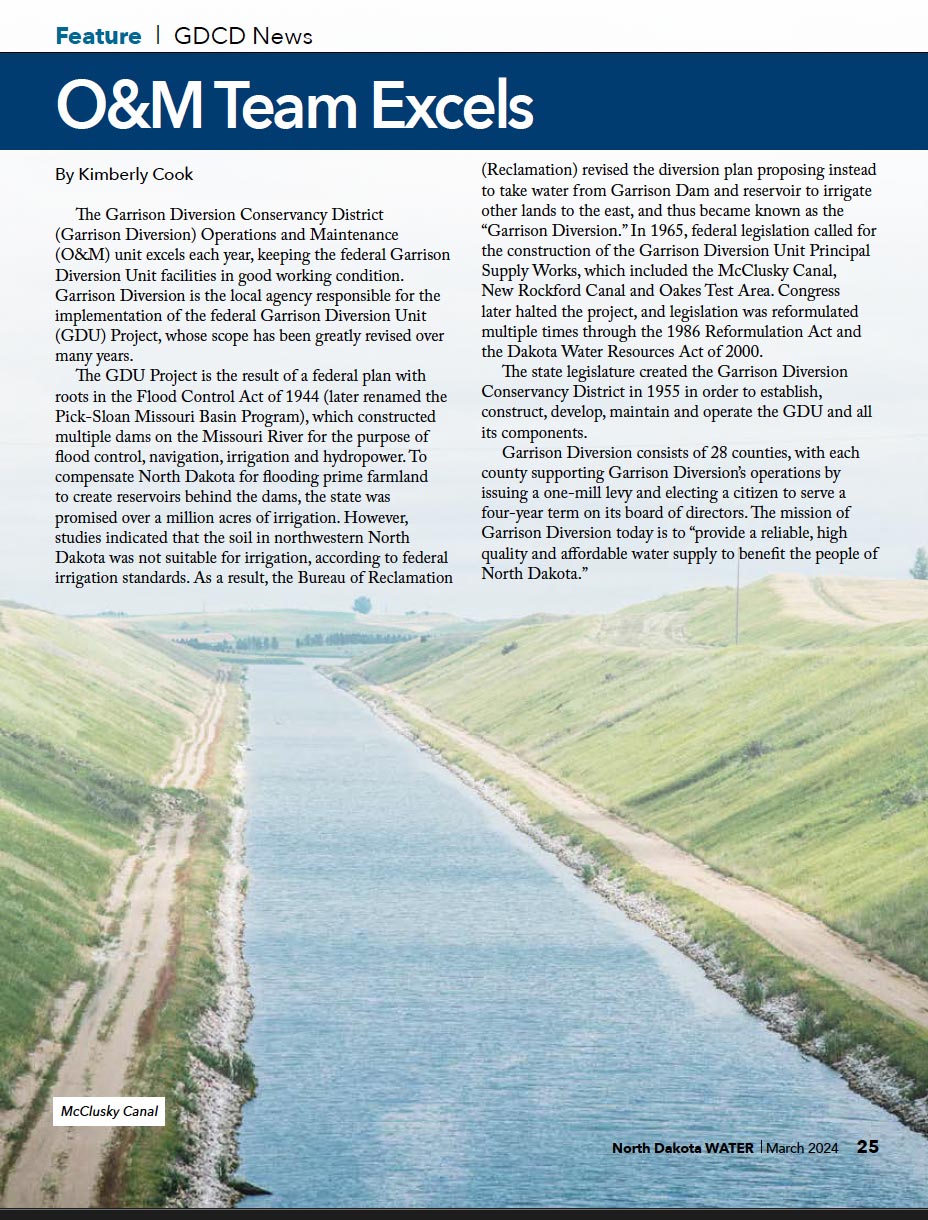
Between 1944 and 1965, soil surveys and studies were performed to assess the feasibility of irrigating the 1.2 million acres originally planned for North Dakota. The studies indicated that the soil in northwestern North Dakota was not suitable for irrigation according to the federal irrigation standards. Drainage problems caused by the unusual high density of glacial subsoil was a primary factor. As a result, the United States Bureau of Reclamation (USBR) revised the diversion plan proposing instead to take water from Garrison Dam and Reservoir and irrigate other lands to the east. With the new name "Garrison Diversion," USBR 1957 feasibility study on the redesigned project recommended irrigation of 1,007,000 acres and other water development in central and eastern North Dakota.
Garrison Diversion Unit
Because of changes to the original plan, and the language in the 1964 appropriations act requiring specific reauthorization for all units of the PSMBP, USBR returned to Congress for reauthorization. During the process of reauthorization, supporters of the project pointed to the many benefits for North Dakota and the need to compensate the state for land inundated by the construction of the Garrison Dam and Reservoir. Others in Congress criticized the large cost of even the scaled-down project, the conflict with federal farm policies, and the relatively small amount of money to be repaid by water users.
On August 5, 1965, Congress addressed these concerns by enacting legislation for the Garrison Diversion Unit. The primary focus of the plan was to include in the initial stage municipal and industrial water, fish and wildlife development, recreation and flood control along with irrigation of 250,000 acres. Between 1968 and 1984, construction and preparatory activities progressed on many features.
Garrison Diversion Unit Commission
Even as construction advanced on Garrison Diversion throughout the '70s and '80s, it became increasingly apparent that major issues, such as environment, the acquisition of lands, economics of irrigation, and Canadian concerns about water flowing from the Missouri River Basin into the Hudson Bay Basin would require reformulation of the project if it were to be completed. In 1984, construction was halted, and a high level commission was appointed by the Secretary of Interior to study and recommend a change in direction.
The GDU Commission, in its Final Report issued December 20, 1984, recommended development of a GDU significantly different from the project described in the 1957 feasibility report and the project authorized in 1965.
The major recommendations were:
- Irrigation of 130,940 acres of land, none of which drains to the Hudson Bay. Of these, 17,580 acres would be located on the Indian reservations of Fort Berthold and Standing Rock.
- A grant program of $200 million to facilitate municipal, rural and industrial MR&I water service for as many as 130 towns and cities, rural areas, and three Indian reservations.
- A water treatment facility to treat Missouri River water that would be transferred into the Hudson Bay drainage via the Sheyenne River and then the Red River. This would provide MR&I water for Fargo, Grand Forks, other cities and rural systems. The cost of the building and operating the treatment plant was declared non-reimbursable.
- Mitigation of wildlife impacts on a new basin with specific wildlife features authorized beyond the mitigation requirements.
- Recreation development on a 50-50 cost-share basis.
- The cost of the Commission Plan was estimated at a total of $1.12 billion in capital costs, including expenditures to date, and $15.8 million in annual operation, maintenance and replacement costs. Of major concern to the state of North Dakota and the District was the proposed elimination of Lonetree Dam and Reservoir and replacement with the Sykeston Canal. Lonetree was the project's principal regulating reservoir; without it, future expansion was limited. Lonetree Dam and Reservoir remained authorized features of the Commission Plan; and construction funds may only be requested after a finding of need by the Secretary and satisfactory consultation with the Government of Canada.
Garrison Diversion Unit Reformulation Act
As a provision of the fiscal year 1986 appropriations, Congress stipulated that new construction contracts not be awarded or additional land be acquired unless the project was reauthorized by March 31, 1986. The State of North Dakota and the District subsequently elected to support reauthorization of the project. The Garrison Diversion Unit Reformulation Act of 1986 was signed into law May 12, 1986, to authorize the recommendations of the Garrison Diversion Unit Commission's Final Report. In conjunction with the new act, a "Statement of Principles" was signed by all the primary stakeholders in the previous project conflicts.
Following the 1986 Act, activities began on MR&I projects, mitigation and wildlife habitat, and construction continued on some of the water delivery features. The continued evaluation of a smaller Lonetree Reservoir as a project feature and further analysis of the recommended Sykeston Canal, deferred progress with construction of the principal water delivery facilities. The President, in 1990, failed to include any funding for the Garrison Diversion Project in his submitted FY 1991 budget.
In connection with the Administration's decision to terminate Garrison Diversion funding in FY 1991, the Secretary established a task group to develop a policy on support for future funding of the authorized project. The task group's decision was to continue funding only those features of the reformulated project which are consistent with the contemporary water needs, national priorities, and the history of Garrison Diversion, but not to fund features which would be used for mitigation. The recommendations also included continuation of the MR&I grant program, Indian MR&I water supply programs, irrigation development on 17,580 acres to include two Indian reservations, continued operation for the Oakes Test Area research activities, recreation, fish and wildlife mitigation and enhancement initiatives, and a minimum level of O&M on the already constructed main supply system facilities. Funding for these features would be considered by the administration within the context of national priorities. Funding for completion of the non-Indian project irrigation facilities and for related principal after supply works were completed would not be considered.
Collaborative Process
In November 1993, the North Dakota congressional delegation and the governor requested that USBR initiate a collaborative process to find a consensus plan that would meet the contemporary water development and stewardship needs of the state. The collaborative process included representatives of the Standing Rock Sioux, Devils Lake Sioux, Three Affiliated Tribes, the congressional delegation offices and the governor's office. The USBR provided technical and administrative support. Under the guidance of the collaborative group, the Bureau began a series of studies for the water supply needs of the state.
In 1995, the North Dakota State Legislature repealed a portion of the North Dakota Century Code dealing with the preservation of wetlands. The National Wildlife Federation interpreted this action as withdrawal of State support for the Statement of Principles and withdrew from the collaborative process.
Garrison Diversion Today
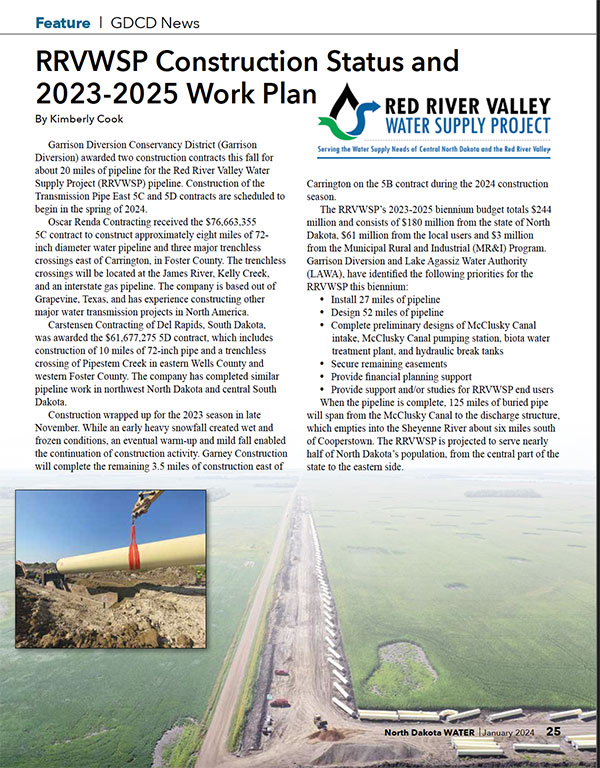
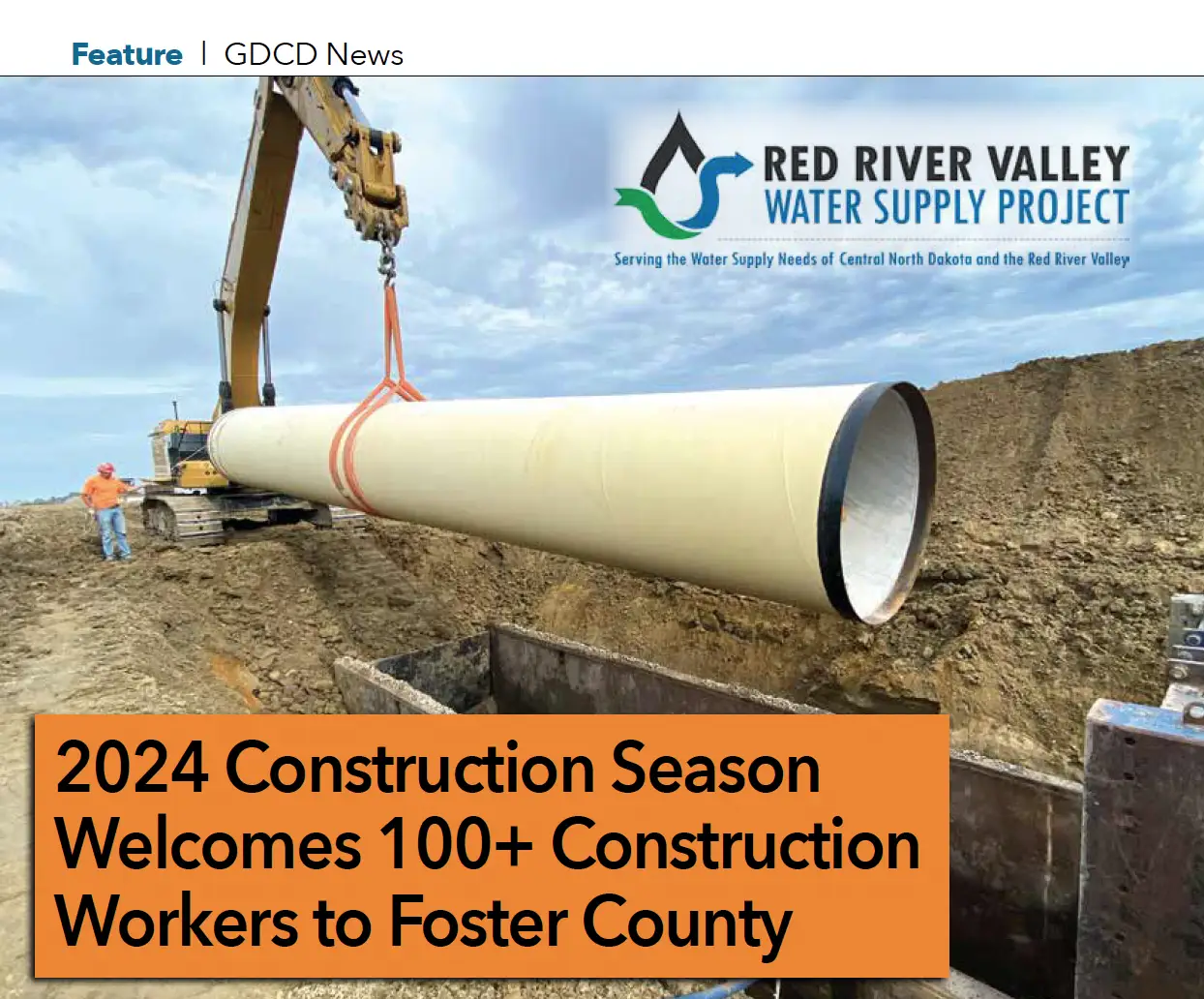
Today, Garrison Diversion has turned part of its focus toward supplying the Red River Valley with a reliable supply of quality drinking water. Research suggests that a strong possibility for a drought such as the one that occurred in the 1930s could hit the Red River Valley at some point in the next five decades. This drought could be of the same magnitude as the 1930s drought, or it may be worse. With the rising population of cities like Fargo-Moorhead, the water demand during a drought would be even greater than in previous decades. Because of water's vitality to the survival of the Red River Valley, Garrison Diversion has pledged to work toward finding a solution to this problem.
DWRA calls for $200 million of federal appropriations for the Red River Valley Water Supply Project (RRVSWP). The study begain in 2000 with a Memorandum of Understanding signed between the state of North Dakota, represented by Garrison Diversion, and the federal government, represented by Reclamation. Seven action alternatives have been explored in addition to a No Action Alternative, which looks at the future of the Valley without the RRVWSP.
As mandated by DWRA, Garrison Diversion and Reclamation are preparing an EIS in order to explore potential environmental impacts caused by the RRVWSP. This document will be reviewed by the public, and the final EIS is expected in December of 2006.
After reviewing information from approximately 40 studies, the Garrison Diversion Board of Directors selected their preferred alternative, the GDU Import to the Sheyenne River, on October 7, 2005.
Also included in the DWRA are appropriations for a $200 million increase in the Municipal, Industrial and Rural fund, $200 million to meet the Native American Indian water needs and $32.5 million for environmental and recreation needs.
All of the future Garrison Diversion facilities and programs would meet the requirements from previous legislation and would deliver and meet the demands and needs of the state for a high-quality, reliable source of water.